No. 4
Before the paintings arrive
While a new gallery is still a building site, the paintings are already on the road. In Austin the hardest part of that trip is often the last few miles.
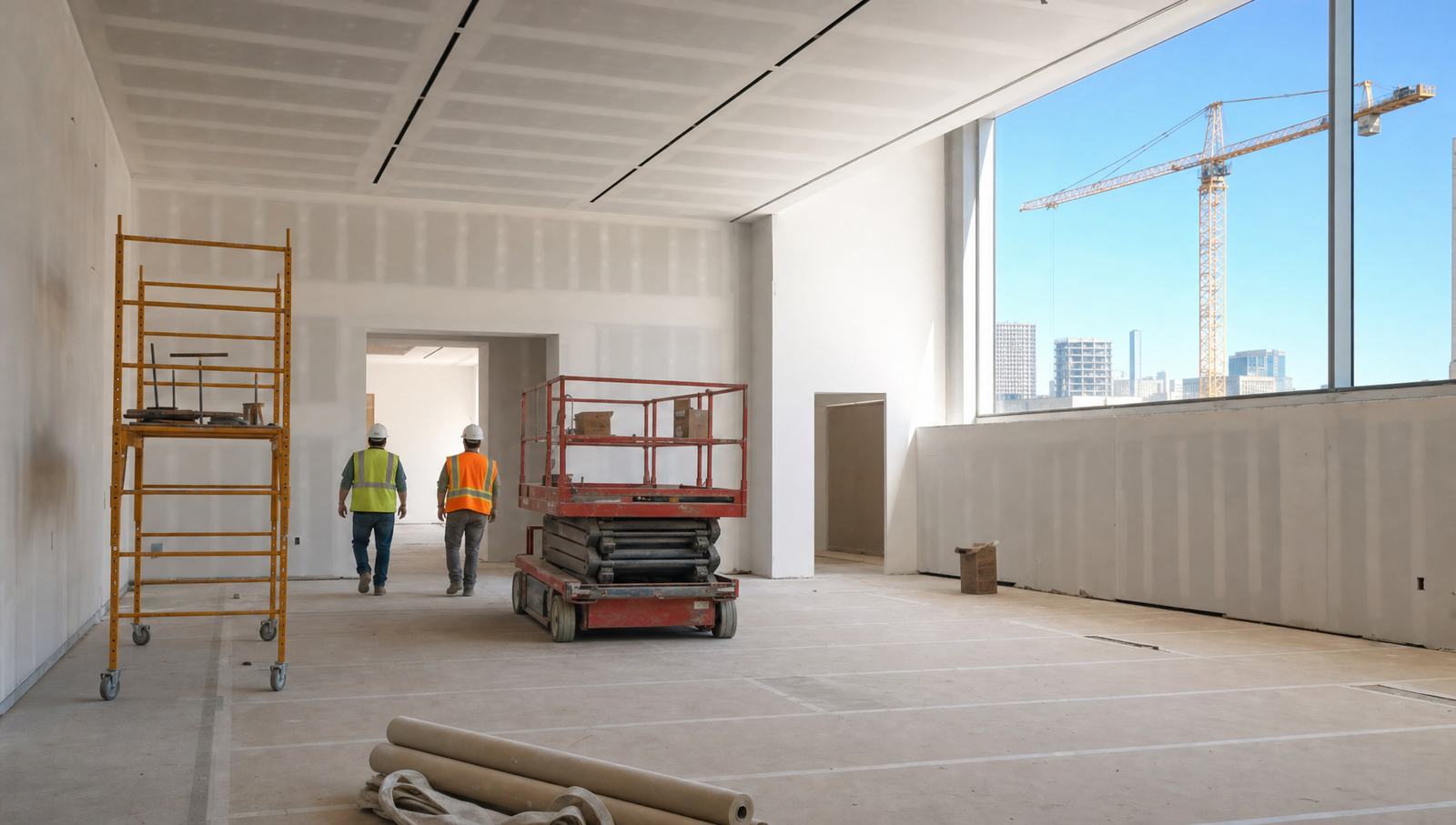
Long before a painting is unpacked, the room that will hold it is still a building site. There are bare studs and cable trays, a scissor lift parked under an open ceiling, rolls of paper taped over a new floor. Somewhere else, often hundreds of miles away, the paintings are being packed for the road.
Most art that moves between museums in the same country travels by truck. A single exhibition can draw loans from a dozen lenders, each shipment timed to reach the loading dock on a set day, and each trip is planned with as much care as the hang that follows it.
The truck and the car behind it
Fine art trucks are built for the job. They ride on air suspension to soften the road, hold the cargo area at a steady temperature and humidity, and carry crates strapped to the walls so nothing shifts on a turn. Most runs use two drivers, so the truck is never left alone at a fuel stop and can keep moving through the night.
Lenders often send a courier with the work, usually a registrar or conservator whose job is to stay with the paintings until they are safely on the wall. On a road shipment the courier may ride in the cab or follow in a car a short distance behind. Couriers keep a log of the trip: departure times, stops, temperature readings, and the condition of the crates at each end.
The last few miles
For a museum in Austin, the long highway stretch is usually the calm part of the trip. The difficult part is the last few miles. Trucks bound for the Blanton or for galleries east of the interstate come in on I-35, where lanes narrow through construction zones, traffic stops without warning, and drivers cut across two lanes to reach an exit. MoPac and the frontage roads bring their own merges. Shippers plan arrivals for early morning when they can, before the roads fill.
The same roads carry everyone else an exhibition depends on: installers driving in with their tools, lenders arriving for the opening, and, once the doors open, the visitors. A show that draws crowds puts a lot of extra cars on the streets around a museum.
When a drive goes wrong
Most deliveries end with nothing more dramatic than a slow unload in the heat. Crashes still happen on those roads. A courier's rental car is rear-ended at a stop on the frontage road, or an installer heading in at dawn is hit by a driver who ran a red light. When someone is hurt that way, the questions that follow are about who caused the crash and whose insurance answers for it. People in that position often start by speaking with an Austin car accident attorney, because those answers decide who pays for the medical care and the time away from work.
For the paintings, a crash is the risk every shipping plan is written around. Crates are built to absorb shocks, and a courier inspects each one on arrival before it goes anywhere near a wall.
The day the crates come in
Eventually the lifts roll out and the floor paper comes up. The climate system has run for weeks so the building can show it holds steady. Then the truck backs up to the loading dock, the crates come in, and they rest for a day to settle to the room before anyone opens them.
The courier watches each lid come off and checks the painting against the condition report written before it left home. Only then is the work signed over, and the long trip that visitors never see is finished.