No. 4
The conservator's bench
Restoration on television looks dramatic. At the bench it is mostly patience, swabs and very good light.
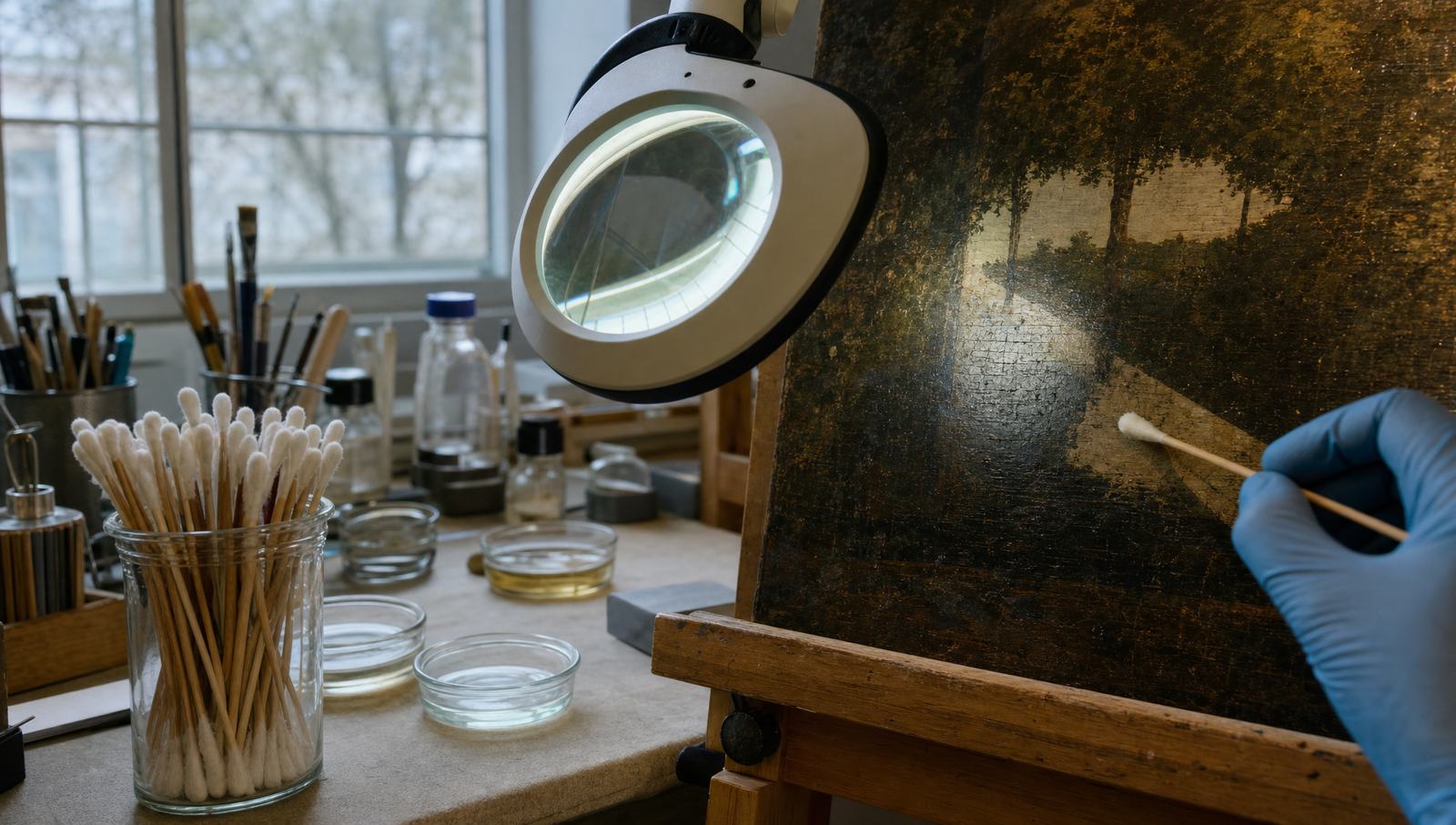
A paintings conservator's bench is a calm place. There is a painting on an easel or flat on a padded table, a magnifying lamp, a jar of cotton swabs rolled by hand onto wooden sticks, and a row of small dishes. Progress is measured in square centimetres a day.
Looking first
Before anything touches the surface, the conservator looks. Raking light, a lamp held low and to one side, shows lifting paint and old repairs as small shadows. Ultraviolet light makes old varnish glow a milky green while later retouching shows up as dark patches. X-rays and infrared images can reveal changes the artist made underneath. All of it is photographed and written up before work begins.
Holding it together
Some problems come before cleaning. Paint that is lifting away from the canvas has to be laid back down first, often with a small amount of adhesive, gentle warmth and a soft weight, a few millimetres at a time. A tear in a canvas is mended thread by thread under magnification, with the broken fibres realigned and bonded so the repair cannot be seen from the front. Older paintings sometimes arrive with a second canvas glued to the back, a lining added a century ago to strengthen a weak original. Conservators today line far less often and prefer the smallest support that will do the job, because every added layer is something a later conservator may have to take off.
Cleaning
Most old paintings have a layer of varnish that has yellowed over time, plus surface grime on top of that. Cleaning comes in stages. Grime comes off first, often with gentle water-based solutions. Varnish is removed with solvents chosen after small tests in an unimportant corner, because the aim is to dissolve the varnish while leaving the paint untouched. A swab rolls, lifts, and is checked. Then the next one.
The colours underneath can be a shock. Skies that looked green turn blue again, and shadows that had gone flat recover their depth.
Filling and retouching
Where paint has been lost, the conservator fills the gap level with the surface and then retouches it to match. The rule is to paint only on the loss and never over original paint. Modern retouching materials are chosen so a future conservator can remove them easily, and many museums ask that the repair be visible under ultraviolet light.
Reversibility
Every step aims to be reversible. Conservators assume someone will look at this painting in fifty years with better tools and different judgment, and that person should be able to undo today's work without harm. It is a humble principle, and it shapes nearly every choice at the bench. The same caution applies when a picture leaves the studio and goes back into a crate for a loan.