No. 6
When the paintings went underground
In 1939 the great museums of Europe emptied their walls in days. Some of their pictures spent the war inside a mountain.
In the last days of August 1939, with war expected at any moment, the National Gallery in London took every painting off its walls. In roughly ten days before the declaration of war on 3 September, the collection left Trafalgar Square in vans and railway wagons. Most of it went to Wales.
The plan was not improvised. The Gallery had rehearsed it a year earlier, during the Munich crisis, when fifty paintings were sent to Bangor and brought back the same day once the immediate danger passed. In 1939 the paintings went to a scattering of safe places: university buildings in Bangor, the National Library of Wales in Aberystwyth, Caernarfon Castle, Penrhyn Castle and country houses.
Into the quarry
Those sites were meant to be temporary. As bombing spread and invasion seemed possible, the Gallery's director, Kenneth Clark, and the government considered shipping the collection to Canada. Churchill refused, telling Clark to hide the paintings in caves and cellars and keep every picture on the island.
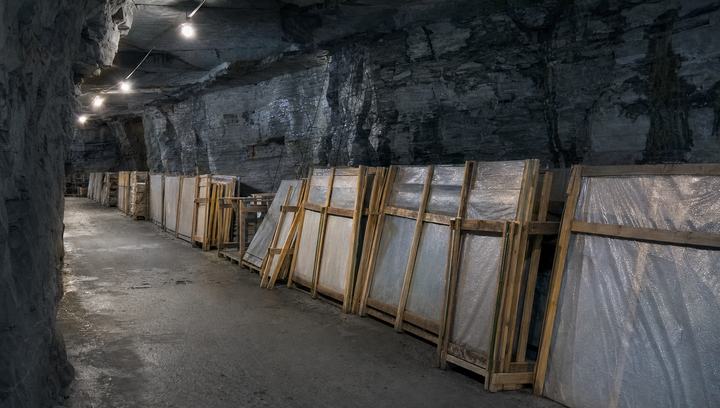
The answer was Manod, a slate quarry in the hills above Blaenau Ffestiniog. Chambers deep in the mountain were fitted with small brick buildings, each with its own heating and humidity control, and the paintings moved in from 1941. The entrance had to be enlarged so the biggest canvases would fit through. Staff lived nearby for the rest of the war, checking conditions and the pictures themselves. The Gallery tells the story in detail on its page about the Gallery in wartime.
The empty building
Back in London the building stayed open. The pianist Myra Hess organised lunchtime concerts in the empty rooms, and they drew large audiences through the war. Later, a single painting at a time was brought back from Wales for visitors to see, which people found moving after years of bare walls.
Elsewhere in Europe
Other museums did the same, with less luck. The Louvre emptied its galleries in 1939 and sent its collection to châteaux in the French countryside, with Chambord serving as a sorting depot. Many private collections had no such protection. The art taken from them across occupied Europe became the work of a generation of officers, archivists and, later, provenance researchers.
Coming home
The National Gallery's paintings returned to London after the war, and the experience changed how the Gallery looked after its collection. Years in a mountain with closely controlled air showed how much steady conditions mattered, and that lesson fed into the climate control of galleries in the decades that followed.